Distributed Blackness
On Black joy and so much more in André Brock's book
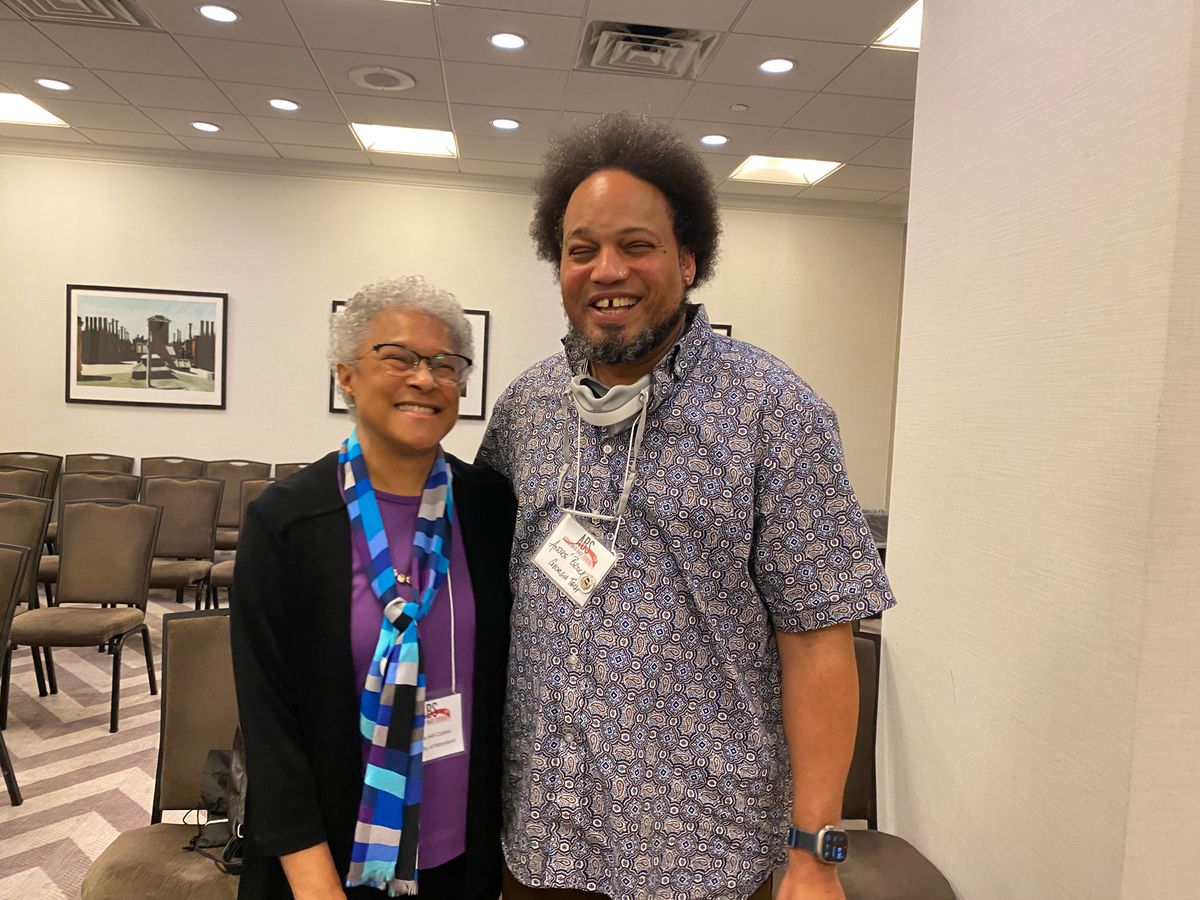
Back in August, I attended a couple of conferences in Philadelphia. One of those conferences was the Association of Black Sociologists, which may be my favorite new scholarly society. There I did an “author meets critics” session organized (by Professor Kevin Winstead) around the book my friend published a couple of years ago. Read to the end for the sociology-celebrity in the audience. Here are the remarks I delivered (on 17 August 2023).
OPENING
André Brock, Dr. Brock, Doc Dre… has given us a magnificent, magisterial book in Distributed Blackness: African American Cybercultures (NYU Press, 2020). For me, someone who is trained as a sociologist, Distributed Blackness is very much in the tradition of W.E.B. DuBois. By that I mean, as DuBois did with his work in The Philadelphia Negro and The Souls of Black Folk, Brock eschews the deficit lens of the white gaze and looks at the lives of African Americans as if these lives matter on their own terms, and does so in a way that radically subverts the whiteness of the dominant technoculture in both theory and practice.
Indeed, Brock invokes DuBois’s work in perhaps one of my favorite sections in the book about reflexivity, interiority and the digital:
Du Bois argues that white people often ask Black people, “How does it feel to be a problem?” (1984 [1903], p. 43). Black responses to this question are often interpreted as resistance in cultural studies or social science research. However, a libidinal economic perspective affords the contention that resistance is powered by the emotional energy engendered by reflexivity. That is, to resist white supremacy, Black folk must evaluate both the ontology and the epistemology—the what and the why—of that racial ideology as well as how the methodology of white supremacy affects them on a daily basis.” (p.154, 2nd italics, emphasis added)
CONTEXT
I want to say just a word about how remarkable the achievement of Distributed Blackness is given the perspectives of those writing about technology that I, and a few years later, André entered as a grad student. In the early 2000s, most of the leading scholars who were interested in the rise of the popular Internet very much saw it as a place where everyone would go to “escape” race (and other forms of embodiment). Noted media scholar Henry Jenkins, for example, in 2002 for the MIT Technology Review, writes:
“Like many white liberals, I had viewed the absence of explicit racial markers in cyberspace with some optimism-seeing the emerging ‘virtual communities’ as perhaps our best hope ever of achieving a truly color-blind society.”
Jenkins goes on to recount his shock and dismay at learning about the racist abuse that several Asian American interlocutors describe experiencing in a supposedly “color-blind” online forum. Jenkins, a professor of communications at USC, in his 20+ year column at MIT Technology Review, only broaches the subject of race again in a 2008 interview with Sarah Gatson. Then, in a blog post the following year (2009), Jenkins poses the question (in conversation with Dayna Cunningham), “Can African Americans Find Their Voice in Cyberspace?” This was what was being served in the field of communications when André entered.
I wish I could tell you that sociology in the early 2000’s was a more welcoming space for researchers interested in digital technologies, but it was not. When a handful of sociologists began to express interest in this area of study and rather late at that, it was to examine the “digital divide,” that is, how supposedly impoverished Black and Brown people could not manage to get connected to this new technology. The tone of these articles was often one of concerned white benevolence, pity and charity. When I spoke to one sociologist (forgotten his name) who had done work in this area for a brief period, he told me: “Yeah, I lost interest when the gap began to close.” That is, when Black and Brown people were fully agentically online and no longer the objects of pity or study, that is when he lost interest. This perspective on the “digital divide,” is what scholar Anna Everett accurately named as a “disabling rhetoric” (Everett, 2002). This, too, was the field into which André entered as a graduate student.
Suffice it to say, as a scholar Dr. Brock’s work has put the lie to several ideas: that digital cultures were ever “color-blind,” and that African Americans are somehow lost within digital culture unable to “find their voice.” His work also thoroughly demolishes those early notions of the “digital divide.”
It is not only his work that has changed our thinking, but the world has changed. There’s some debate about the precise year (2007 or 2008) but in the late aughts of this century, we witnessed the rise of the algorithmic Internet. That allowed for the emergence of Twitter, and the creative jouissance that is Black Twitter (even under Apartheid Clyde), which is the focus of much (but not all) of Distributed Blackness. There are many contributions in this book about African American cybercultures and I want to enumerate some of those before returning to this idea of jouissance, which I see as central to Brock’s thinking here.
CONTRIBUTIONS
· Scope: Brock argues for a “Black technocultural matrix,” which he defines as the interweaving of technology, culture, self, and identity. The Black technocultural matrix includes six aspects: Blackness, Intersectionality, America*, Invention/Style, Modernity, and The Future. Sometimes, in reading about the book, I see some refer to it as a book “about Black Twitter,” which it is and it is SO MUCH MORE than this. The scope and scale of the book is DuBosian in its ambitious scope and not at all restricted to just one platform.
· Methods: I’ve been fortunate to have served on several dissertation committees as an outside reader / external reviewer, many of these outside the U.S. Let me tell you that what I’ve seen is that Dr. Brock’s innovation of critical technocultural discourse analysis (CTDA) is everywhere in this exciting new work. CTDA is the go-to method now for those just beginning their careers. This has helped move several fields forward, including but not limited to African American Studies, Critical Internet Studies, Communications, Digital Humanities and Digital Sociology.
· Theory: There are a number of theoretical contributions in Distributed Blackness and I want to highlight Brock’s use of the libidinal economy. Here, he is drawing on the traditions Lacan and Lyotard (2015). And he is extending the work of scholars such as Lu and Steele (2019) as well as Wilderson, who writes:
“libidinal economy functions variously across scales and is as ‘objective’ as political economy. It is linked not only to forms of attraction, affection, and alliance, but also to aggression, destruction and the violence of lethal consumption… it is the whole structure of psychic and emotional life… something more than but inclusive of or traversed by … a ‘structure of feeling’; it is a dispensation of energies, concerns, points of attention, anxieties, pleasures, appetites, revulsions, phobias capable of great mobility and tenacious fixation (Wilderson, 2010:7)”
I didn’t know this theory before reading Brock’s work and so I’m grateful for this introduction to this important concept. Right now, I’m still wrestling with how to use libidinal economy to inform my own work but I want to set that aside for now and instead to turn to another concept nestled within this theoretical framework.
· Black Joy: In Distributed Blackness, Brock calls our attention to the centrality of Black joy – the jouissance -- in the creation, flourishing and sustenance of Black Twitter, which I believe all of us in this room have witnessed, experienced and/or participated in. Here I think is one of the strongest contributions of this work for the way it radically subverts the dominant voices in the discipline of communication and the “disabling rhetorics” of sociological studies, both of which are rooted in a deficit model.
And this is really where I want to riff a little on Brock’s work and his exploration of Black joy, and of joiussance, that is, the enjoyment and creativity that Black people bring to whatever they do. Beyond Twitter, my most profound experiences of Black joy are at roller skating rinks under a disco ball. I grew up skating in the style that I learned at Skateland in Corpus Christi and the imperative there was to either go as fast as you could around the other, less skilled skaters, OR, do ice-skating-inspired twirls and spins in the center of the rink. Even though Skateland was what Elijah Anderson would call a “cosmopolitan canopy,” because we kids – Black, Mexican + Anglo - would gather from all over Corpus to skate there, the style of skating I learned was, nevertheless, entirely shaped by a white dominant culture.
I still find joy in roller skating. Today, my roller skating practice happens most often in predominantly Black spaces, like Cascade in Atlanta, the Branch Brook Park in Newark, NJ, or on Monday nights at United Skates out in Seaford, Long Island.
What I experience in Black roller skating is the exquisite embodiment of joy. I marvel at the skill, the grace, the care and inclusivity for the other skaters, the queerness and homoeroticism, and the way that Black people elevate roller skating to an art form.
When I skate with a predominantly white crowd, I’m very good. When I skate with a predominantly Black crowd, I will never be anything but mediocre and I am more than ok with that because what I lose in “mastery” I gain in proximity to Black joy and a profoundly de-centered whiteness, both of which I find deeply healing from the trauma of being raised-white, the loneliness of white individualism with its attendant careerism and the comparatively meager joy available through whiteness.
Now I want to turn to how I am reading Brock’s work to inform my own. Brock deploys Afro-optimism to invite us to imagine a world in which technology embraces Black innovation and creation. He writes:
In my reformulation, Blackness reintegrates the mind and body, returning authorial control and intent over those aspects of Blackness to Black culture. The matrix quality of Blackness, then, is the communitarian enactment of intentionality across cultural aspects of Black culture. As Moten (2013) says, “Blackness is . . . irreducibly social” (p. 739).
I think about this formulation often – in roller skating and in research – that Blackness is social in a way that leads to jouissance, something that whiteness does not have the capacity to do, with its individualism, careerism, and opportunism.
In research, I think about this formulation especially when it comes to the erasure of Black women’s contributions to disinformation studies and the ways that (mostly) white women scholars have encircled, enclosed, and captured this field to exclude Black women even as it extracts their insights in the service of individual careerism.
In my recent book, Nice White Ladies (2021), I identified the sadomasochism at the heart of whiteness and the way it gets passed down intergenerationally in white families. Here I drew on the powerful work of Stephanie Jones-Rogers’ They Were Her Property (2019), and the imaginative sadism I witnessed in my own family. So, with Brock’s work I’m juxtaposing Black joy with the sadism (+ masochism) in whiteness.
As literary scholar Li-chun Hsiao points out “…the connection between sadistic desire and jouissance is a close one, that jouissance, instead of ordinary pleasure, is what sadistic perversions aspire to” (2003).
American studies scholar Gordon Fraser writes that those on the far right “derive erotic pleasure from the fictional …conspiracies through which they produce paranoid forms of sociality.” (Fraser, 2020, emphasis added). I’ve been thinking about this in connection to the pleasures in white supremacy, as for instance, in Raul Perez’s The Souls of White Jokes (2022), about the visceral pleasure and solidarity that white people derive from telling racist jokes.
We are missing a great deal if we think of white supremacy only in terms of “hate” when there is pleasure and enjoyment for some in this violent ideology.
Given this connection between jouissance and sadism, I want to suggest that Dr. Brock’s call for researchers to be explicit about the whiteness of the online communities they study (a call I’ve also made) is a good beginning but it is not sufficient for what we are up against with the global rise of the far right and the coinciding climate collapse.
I contend that we have to take an unflinching view of the deep, libidinal connections between whiteness and white supremacy, and the way sadomasocism is a constituitive part of both.
I also want to suggest that we need to reimagine whiteness not simply as an individual “identity,” but rather as a kind of collective psychosis that poses a serious threat to Black joy (and life) in whatever space it animates, whether roller skating rinks or Twitter.
In closing, I want to return to DuBois who I think of as our kind of North Star in sociology, a guiding light that we can never quite catch up to. (I think of him as I do Octavia Butler, so perceptive about the current condition that is like they are from the future, an Afrocentric future, of course.)
Part of what the example of DuBois’ life’s work does for me is it challenges me to be more radical, to think more globally.
As a final provocation, I’ll simply ask Dr. Brock: How do you imagine a more radical and thoroughly global follow up to Distributed Blackness?
***
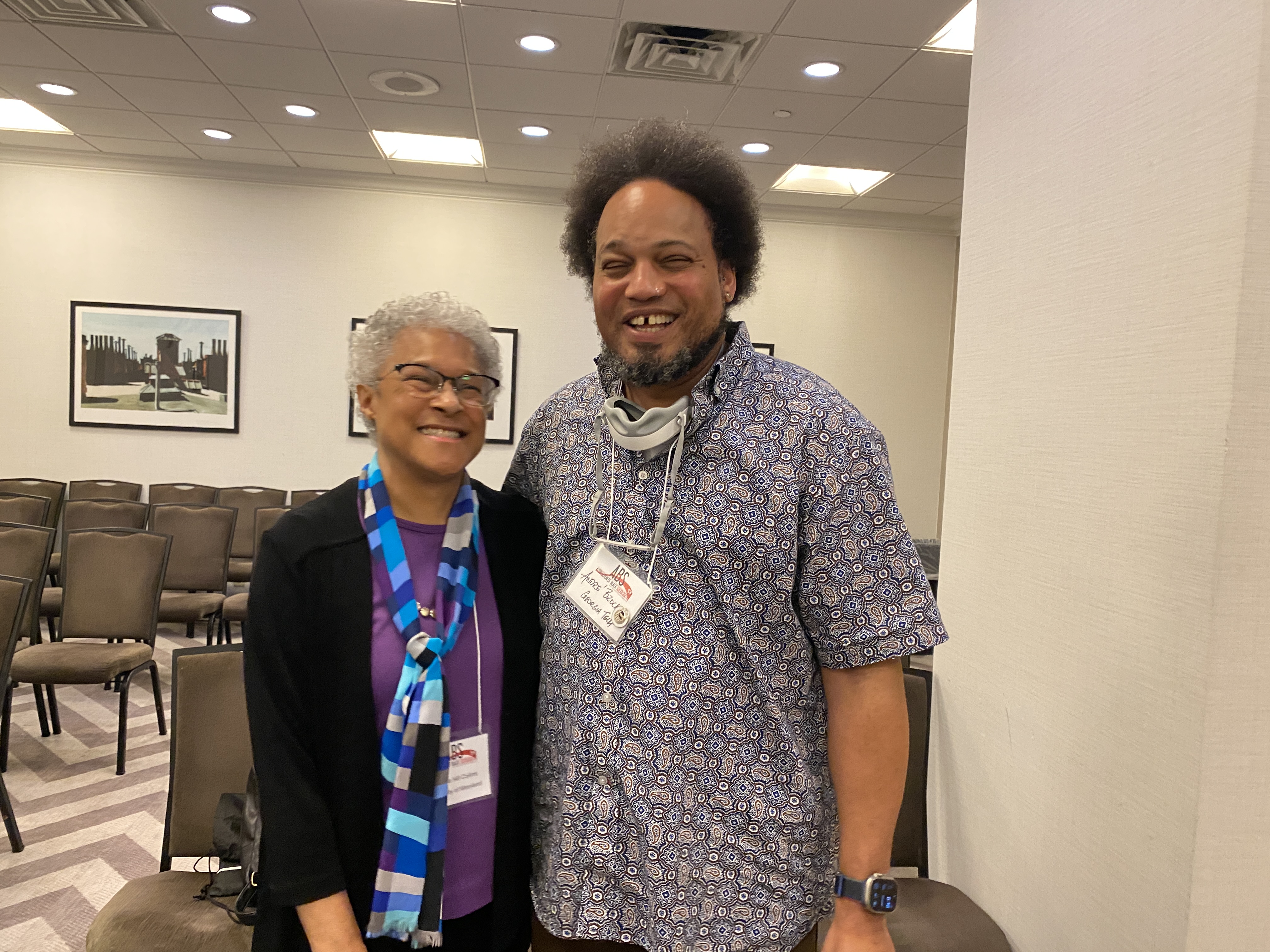
CODA: The special guest in the session was the ONE OF ONE Patricia Hill Collins, author of Black Feminist Thought, among many other books, and the person I studied under as a post-doc at the University of Cincinnati, 1993-94. I did not lose my shit when I saw her walk in. Please clap.
References
Anderson, Elijah. "The cosmopolitan canopy." The Annals of the American Academy of Political and Social Science 595, no. 1 (2004): 14-31.
Brock Jr, André. Distributed Blackness. New York University Press, 2020.
Daniels, Jessie. Nice White Ladies. Seal Press, 2021.
Du Bois, William Edward Burghardt. The Philadelphia Negro: A Social Study. No. 14. Published for the University, 1899.
-----. The Souls of Black Folk. Oxford University Press, 1903/2008.
Everett, Anna. "The revolution will be digitized: Afrocentricity and the digital public sphere." Social Text 20, no. 2 (2002): 125-146.
Fraser, Gordon. "Conspiracy, pornography, democracy: the recurrent aesthetics of the American Illuminati." Journal of American Studies 54, no. 2 (2020): 273-294.
Hook, Derek. "The Mandela Imaginary: Reflections on Post-Reconciliation Libidinal Economy." Remains of the Social: Desiring the Postapartheid (2017): 40-64.
Hsiao, Li-chun. "Thanatos gains the upper hand: Sadism, jouissance, and libidinal economy." Concentric: Literary and Cultural Studies 29, no. 1 (2003): 47-66.
Jenkins, Henry. “Cyberspace and Race: The color-blind Web: a techno-utopia, or a fantasy to assuage liberal guilt?” MIT Technology Review, 1 April 2002. Available online: https://www.technologyreview.com/2002/04/01/101999/cyberspace-and-race/
Jenkins, Henry. “Can African Americans Find Their Voice in Cyberspace?” Pop Junctions (blog post), 4 March 2009. Available online: http://henryjenkins.org/blog/2009/03/can_african-americans_find_the_1.html.
Jones-Rogers, Stephanie. They Were Her Property. Yale University Press, 2019.
Lu, Jessica H., and Catherine Knight Steele. "‘Joy is resistance’: Cross-platform resilience and (re) invention of Black oral culture online." Information, Communication & Society 22, no. 6 (2019): 823-837.
Lyotard, Jean-François. Libidinal economy. Bloomsbury Publishing, 2015.
Perez, Raul. The Souls of White Jokes. Stanford University Press, 2022.
Proudfoot, Jesse. "The libidinal economy of revanchism: Illicit drugs, harm reduction, and the problem of enjoyment." Progress in human geography 43, no. 2 (2019): 214-234.
Tate, Shirley Anne. "The Political and Libidinal Economies of Skin Shade: The Poor Bleach, the Middle Class/Elite Tone/Lighten." Skin Bleaching in Black Atlantic Zones: Shade Shifters (2016): 62-86.
---- and Damien Page. "Whiteliness and institutional racism: Hiding behind (un) conscious bias." In Critical Philosophy of Race and Education, pp. 141-155. Routledge, 2020.
Wilderson III, Frank B. Red, white & black: Cinema and the structure of US antagonisms. Duke University Press, 2010.