Learning from Toni Morrison
White people are still 'Playing in the Dark'
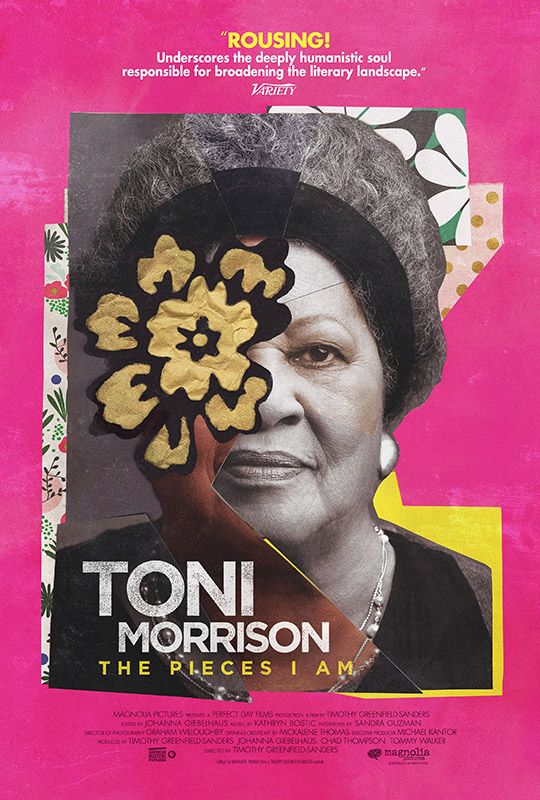
I think about Toni Morrison a lot, at least once a day, sometimes more often. This is by design. At one end of my small New York City apartment, I have a collection of her books displayed on a shelf. At the other end of the apartment, I have a framed version of this poster (below) from the documentary hanging in a place where I see it every time I sit down to write. It is an intimidating image but one that motivates me, the most formidable accountability partner.
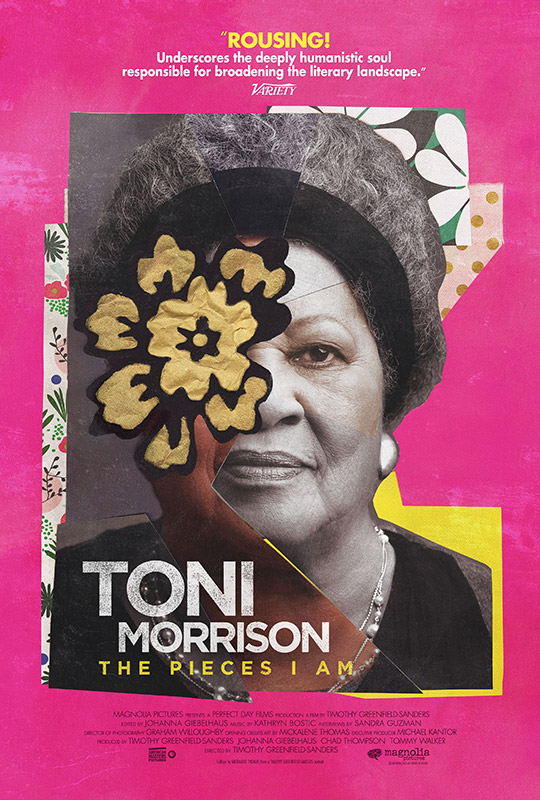
This 2019 documentary, “Toni Morrison: The Pieces I Am,” by Timothy Greenfield-Sanders, has many delightful interviews with the Nobel Laureate and her friends, along with some terrific archival footage of her. I especially treasure this film because it was released the same year that Morrison transitioned (August 5, 2019), so it feels like you can just get a whiff of her powerful life force through this film before she flies away to join the ancestors. I enjoy her presence in this film so much that I’ve lost count of the number of times I’ve watched it. Sometimes I rewatch it just for the epic shade thrown at Oprah (“How’d you get my number?”). I howl with laughter every time.
Of course, Morrison is most well-known for her fiction and deservedly so. I am among those who believe that Beloved is the Great American Novel, and I don’t know of another that’s even close. As Salamishah Tillet shared recently on the New York Times Book Review podcast, it is a novel that can be read again and again, offering new gifts each time. I could never hope to touch the hem of her garment as a fiction writer so when I read Morrison, it is mostly in awe at what she does with the language. I marvel at each sentence.
Morrison also left us with a rich trove of non-fiction writing, including Playing in the Dark: Whiteness and the Literary Imagination, her 1992 book of literary criticism. In it, she writes about the way Africans and African-Americans often function as stand-ins for all kinds of unresolved mess with white characters, but in the vast landscape of American literature there is very little interrogation of those white characters as racialized subjects, or of whiteness itself. Morrison then issues this challenge:
“What I propose here is to examine the impact of notions of racial hierarchy, racial exclusion, and racial vulnerability and availability on nonblacks who held, resisted, explored, or altered those notions.”
This was Morrison writing more than thirty years ago. Still, there have been very few writers who have done this work of writing about whiteness from within it and in a way that tries to dismantle it. In literature, I can think of one writer, Eula Biss, who has done this kind of exploration but I can’t think of others (let me know if I’ve missed one of your faves who does this). In the kind of academic writing I follow about the far right, it is a field that is almost exclusively occupied by raised-white writers and it is almost entirely lacking in self-reflection about this fact. Overall, the response to Morrison’s challenge remains, I’m sad to tell you, a short fucking list.
In the documentary, the filmmaker includes several video clips of Morrison speaking with white male interlocutors (Bill Moyers, Charlie Rose). Each encounter is a master class in flipping the script, of taking the assumptions embedded in the questions and turning them back on the interviewer. She always does this with the utmost confidence, grace, and ease, the epitome of standing in your power, unbothered by the fools around her. In one of these clips, Morrison is confronted with a question that seeks to position her as a victim of racism, and she immediately calls it “the wrong question.” You can watch the two-minute clip here (this platform doesn’t allow me to embed video), but what she says is so powerful, I want to add here in text (emphasis added in bold):
“…don’t you understand that the people who do this, this thing, who practice racism are bereft. There is something distorted about the psyche. It’s a huge waste and it’s a corruption and a distortion. It’s like it’s a profound neurosis that nobody examines for what it is. It feels crazy, it is crazy, and it has just as much of a deleterious effect on white people and as it does Black people.
“If the racist white person, I don’t mean the person who is examining his consciousness and so on, doesn’t understand that he or she is also a race, it’s also constructed, it’s also made, and it also has some kind of serviceability, but when you take it away, if I take your race away, and there you are all strung out and all you got is your little self and what is that? What are you without racism? Are you any good? Are you still strong? Are you still smart? You still like yourself? I mean these are the questions.”
“If you can only be tall because somebody’s on their knees, then you have a serious problem. And my feeling is white people have a very, very serious problem. And they should start thinking about what they can do about it. Take me out of it.”
I feel as if I’ve been grappling with these questions for thirty years, and selfishly, I want more company with me on this journey. I love nothing more than when I meet someone who has already started doing this work and we can dive into the deep end of our discussion about how we’re dealing with the damage whiteness has wrought in our lives. The conversations I’m most interested in having with other white-raised folks these days is: what are you doing to heal from whiteness? I’m surprised, and a little disappointed I guess, that more of my fellow white-raised people aren’t deeply engaged in these questions because I don’t think I’m that special or different than anyone else in this leaky bucket of whiteness.
There are more and more of us, though, doing this work. Just last night I called into SURJ’s national mass meeting about two minutes late and it was already capped at maximum capacity, so yay! Good job showing up, y’all. Yet, that “capacity” was around 3,000 people. In a country of roughly 330 million with around 197 million of those are white folks, we’re still a long way from the kind of mass mobilization we need to deal with our own “very, very serious problem,” in Morrison’s phrase.
Recently, a young woman told me that reading Nice White Ladies made her feel like she “can’t win.” This is a version of the feedback I’ve gotten from more than a few readers. Without getting too far into the psychoanalytic weeds, this is what we call an “ego defense.” The way we’re put together as human beings is that our first instinct when someone attacks our ego is to punch them, either literally or metaphorically, then to avoid the thing that has threatened our ego defenses.
The challenge that Morrison so accurately named for us thirty years ago requires the ability to let go of those ego defenses when they no longer serve us. In her 1977 novel Song of Solomon, Morrison writes: “You wanna fly, you got to give up the shit that weighs you down.” Beloved, hear me when I tell you that whiteness is the shit weighing us down.