Living in a World of Neil Gaimans
Putting an End to Rape Culture
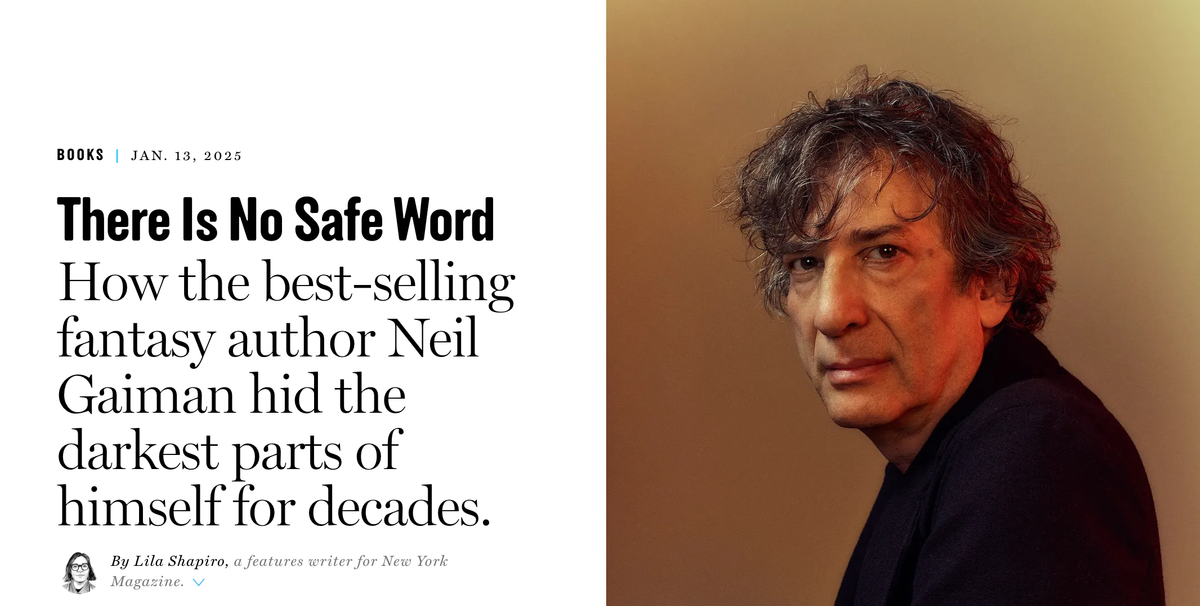
There is a harrowing, well-reported (by Lila Shapiro) cover story in the latest issues of New York Magazine, on Neil Gaiman, a writer who is accused of a pattern of sexual assault of young women in his orbit. Often, the story alleges, these young women were procured by Amanda Palmer, a singer-songwriter and outspoken feminist, perhaps most well known for her crowdfunding efforts to support her music career. Since the NYMag piece dropped, Gaiman has taken to his blog to deny the allegations, no public word from Palmer at this time.
What struck me in reading the piece about Gaiman was how very mundane the whole thing is. If you have read about one of these sexual predators with wealth and fame (e.g., Ailes, Combs, Savile, Weinstein), you’ll recognize the pattern here. Powerful men, often at the apex of their careers, use the aspirations of younger, more vulnerable people, to demand sexual favors, then use their money and influence to silence the victims and escape legal accountability. That’s it. On repeat.
Part of what allows this pattern to continue with impunity is something that sociologists refer to as “rape culture.” Simply put, this is when sexual assault is so pervasive and normalized due to a society’s attitudes about gender and sexuality. You’ve probably heard these common attitudes repeated at your workplace, your school, or in family gatherings. Things like victim-blaming (“she shouldn’t have been out at night/wearing that/in that place”), minimizing the extent of harm from rape (“she probably enjoyed it”) or excusing the actions of perpetrators (“boys will be boys”) are all forms of rape culture. For hundreds of years, it was completely legal for a man to force a woman he was married to into non-consensual sex, and people didn’t even call that “rape,” it was just called marriage.
How did all this change? And, how do we keep pressing for change in rape culture?
It’s feminism. Yeah, I know. I rag on the feminists, especially white feminists. But dismissing the value in feminism - that all women deserve full equality - because of the exclusionary politics of white feminists is the quintessential throwing the baby out with the bath water stratagem. The full measure of feminism is to make it as inclusive as possible. “Feminism is for everybody,” as bell hooks taught us. That includes men.
As I read the Neil Gaiman piece, the thing that struck me was his upbringing in the UK within Scientology, a devastating one-two punch of a childhood that certainly provoked in him a wild imagination that helped him survive. However, along with that damaging childhood, he inherited a deep resistance at looking at himself or doing the necessary excavation of his inner demons. At one point in the reported story, Amanda Palmer says in frustration about Neil Gaiman, “Just the lack of self-knowledge and the lack of interest in self-knowledge.” While Palmer could use some of that self-reflection on the ways she both enjoyed and enabled his predilictions, it is Gaiman’s lack of self-knowledge that is at the root of the wide-ranging harm in this story (and, frankly, in his denial-apology-explanation).
Ironically enough, on the same day I read the Gaiman story, I watched a new documentary, “Enigma,” about the American football player, Aaron Rodgers. I’m not a follower of football, so I didn’t know who he was before I watched it. I think I may have seen some news about him during COVID (covered in the film), but I didn’t pay much attention to him. The second episode in the docuseries (currently on Netflix) is called “Awakening,” and it’s all about Rodger’s journey with plant medicine.
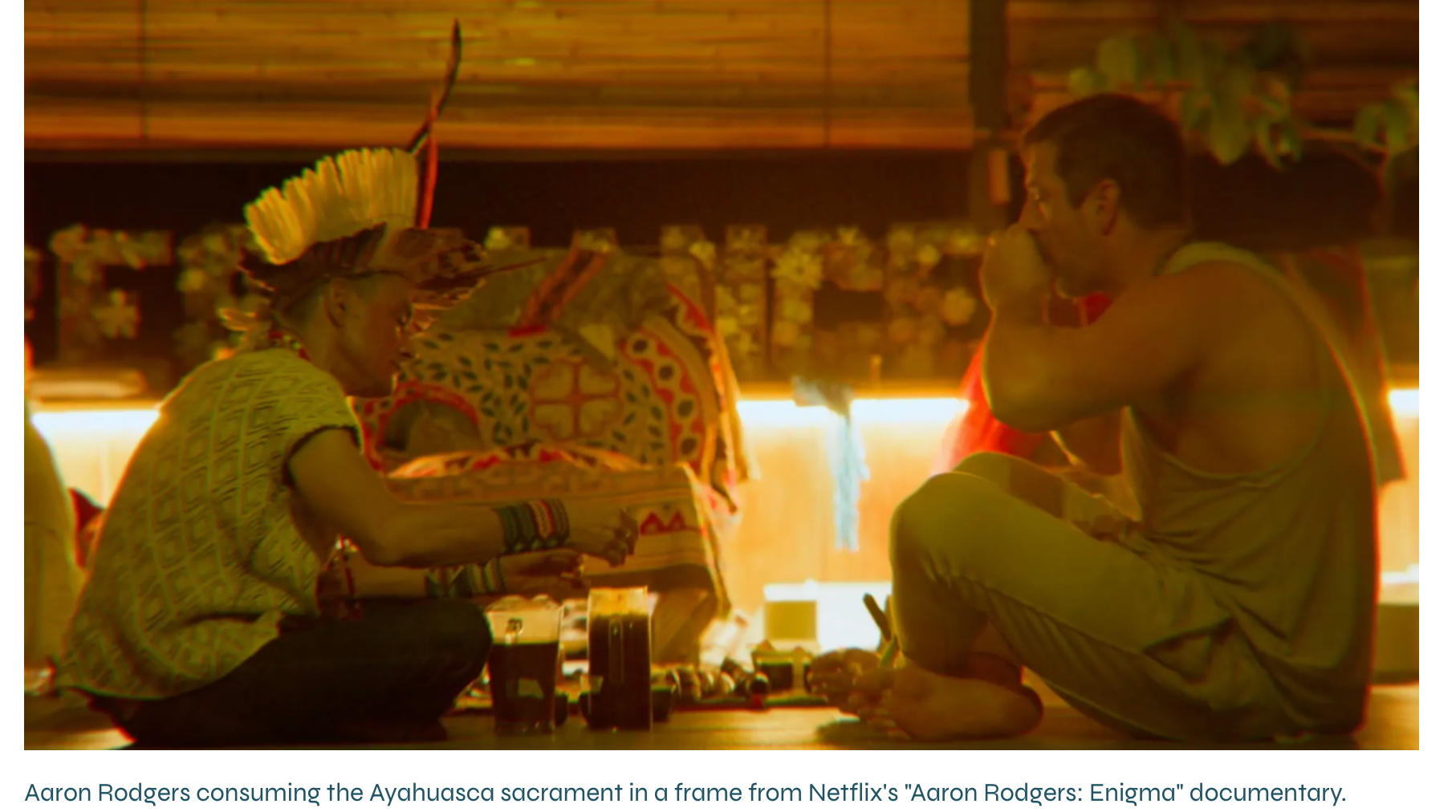
There was something healing about seeing this big quarterback at the height of his career make a different set of choices than most men in this culture. We live in a white supremacist, patriarchal, capitalist society and that creates certain kinds of personalities. It is not that all men are inherently rapists, it’s that men are shaped by and get rewarded for apex predator behavior in a system that indexes for that. For example, there is solid research that finds about 12% of corporate CEO’s have psychopathic traits, that is, caring only about personal gain and unconcerned about the suffering of others. More anecdotal evidence abounds, as we learn more about the backstories of figures like the Orange Mussolini and Apartheid Clyde, both of whom are so desperately trying to heal their childhood wounds, but instead of doing that have accumulated great fortunes and enormous power, leaving a wake of abused and discarded women (and their own offspring) behind them, while endangering all of our lives. So, given this context of predatory masculinity, to see someone like Aaron Rodgers, with all that available to him, turn and make another set of choices is remarkable. While I disagree with Rodgers about his views on the pandemic, I’d much rather live in a world with more of him than with more Neil Gaimans.
So what does it look like to change society so thoroughly that we upend rape culture and predatory masculinity?
There are lots of things that we can do. I think a big part of what needs to happen is economic empowerment for women so they are not trapped by constrained choices. One of the aspects of the Gaiman-Palmer predation that stands out is the way they promised employment, world travel, opportunity, and housing to young women who had little access to those resources. Actual consent requires enough resources to be able to say “no,” mean it, and leave.
We also have to confront the danger of sexual abuse within our relationships. Years ago, when I lived in Austin, I volunteered with the local Rape Crisis Center as part of their Speakers Bureau. We would go around to high schools and middle schools doing a standard presentation on sexual assault for teens and tweens. One of the stats we’d share is that 80% of all sexual assaults are committed by someone known to the victim — a parent, relative, boyfriend or husband. This was in the early 1990s, long before the reign of Law & Order and all the other television shows that hammer home the “stranger danger” narrative about sexual assault, when in reality the danger is inside our homes and our relationships. This includes childhood sexual assault, and there are organizations like Generation 5, working to end this in five generations.
Despite the grim news in the Gaiman piece, change is happening. Something has crossed over in the collective consciousness. In France, the incredible Gisèle Pelicot has stood up to rape culture and said, “Shame must change sides.”
The long trajectory of history is on our side, the side of enthusiastic consent, the side of pleasure and love that doesn’t involve coercion, the side of healing.