Skin in the Game
"Our lives are at stake."
For most of yesterday, I was working from home and following the events unfolding in Tennessee with the news on in the background. As you’ve probably heard already, the #TennesseeThree are Rep. Justin Johnson, Rep. Justin Pearson, and Rep. Gloria Johnson. They joined with protesters last week who were demanding stricter gun laws after the shooting that left six dead, including three nine-year old children, at a Christian school in Nashville.
I saw the results of the first vote when they expelled Rep. Justin Johnson. Shortly after that, I heard Rep. Justin Pearson on the tv-machine, saying:
“Our lives are at stake. And we're going to fight for our lives, just like they're fighting for the NRA."
I had assumed that GOP legislators in Tennessee were going to expel them all.
A little after 7pm, while I was out to dinner with some beloveds, I got a text from my friend Kristie, who lives in Nashville, who reported:
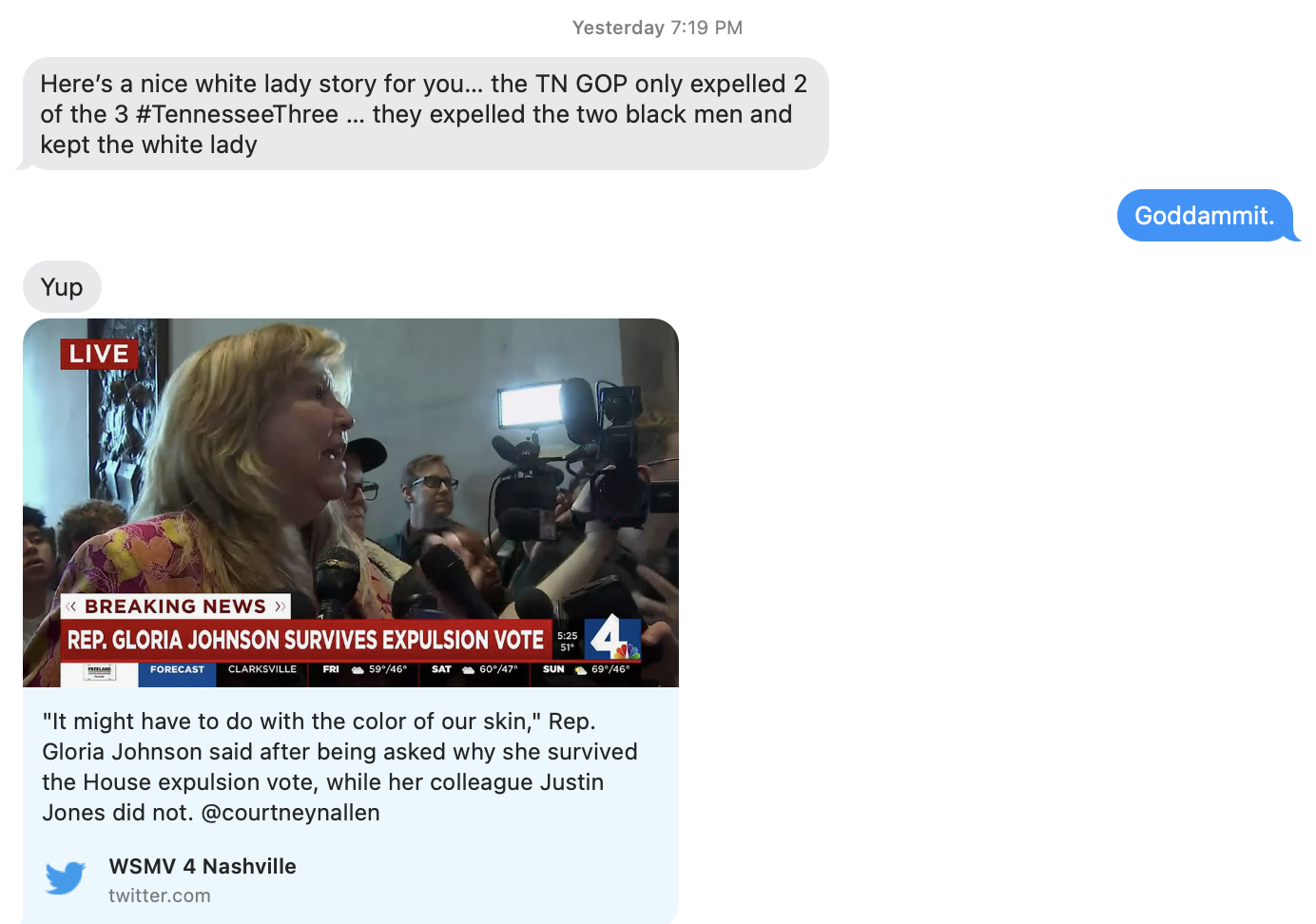
I was shocked. I shouldn’t have been but I was. I mean, I wrote a whole book about nice white ladies, but I underestimated how flagrant the Tennessee GOP was willing to be in their bid to uphold white supremacy, patriarchy, and the capitalist interests of the gun lobby.
The racism in this action by Republicans in Tennessee is obvious and echoes a long pattern of white people treating African American elected officials in a demeaning fashion. During Reconstruction, many white male politicians could not stand the thought of serving alongside free Black men (Black women still couldn’t vote or get elected). In the history I was taught in Texas public schools, white people believed that formerly enslaved people didn’t know how to act in the esteemed halls of state power. If you’ve ever seen that paean to white supremacy, Birth of a Nation, you’ve seen these images. In one scene, Black legislators are depicted as wildly unprofessional, feet up on desks, eating and drinking during sessions, as the caption in the film describes, “the riot in the Master's Hall.” In the U.S., anytime there is even the smallest bit of progress toward liberation for Black folks, you can bet on a rage-filled backlash from white-identified folk. The Tennessee GOP’s move to expel two Black representatives supposedly for issues of “decorum,” is a throwback to the first (failed) Reconstruction.
This word decorum is doing a lot of work here, and it brings me back to the Tennessee legislator who didn’t get expelled, Rep. Gloria Johnson. She didn’t get expelled because at some level her mostly white male colleagues in the Tennessee legislature did not see her as a threat to decorum in the same way they did her two Black colleagues. Let me make this as plain, she is seen as “nice,” that is “dignified propriety of behavior, speech, dress,” the very definition of decorum. No matter how fresh the suit-and-tie they wear, Rep. Justin Pearson and Rep. Justin Johnson, will never be seen as exercising decorum simply because they are Black.
To her credit, Rep. Johnson named what’s happening. In multiple interviews when asked why do you think you were treated differently, she’s said:
“I think it is pretty clear. I am a 60-year-old white woman, and they are two young Black men.”
Good job, Gloria! And this is the entire reason I wrote that book, so that we — all the white-raised, femme-identified people — could show up in solidarity with other people from different backgrounds. Not leading, not saving, not pitying, not helping. But standing shoulder-to-shoulder, because we have skin in the game. Our lives are at stake, too.
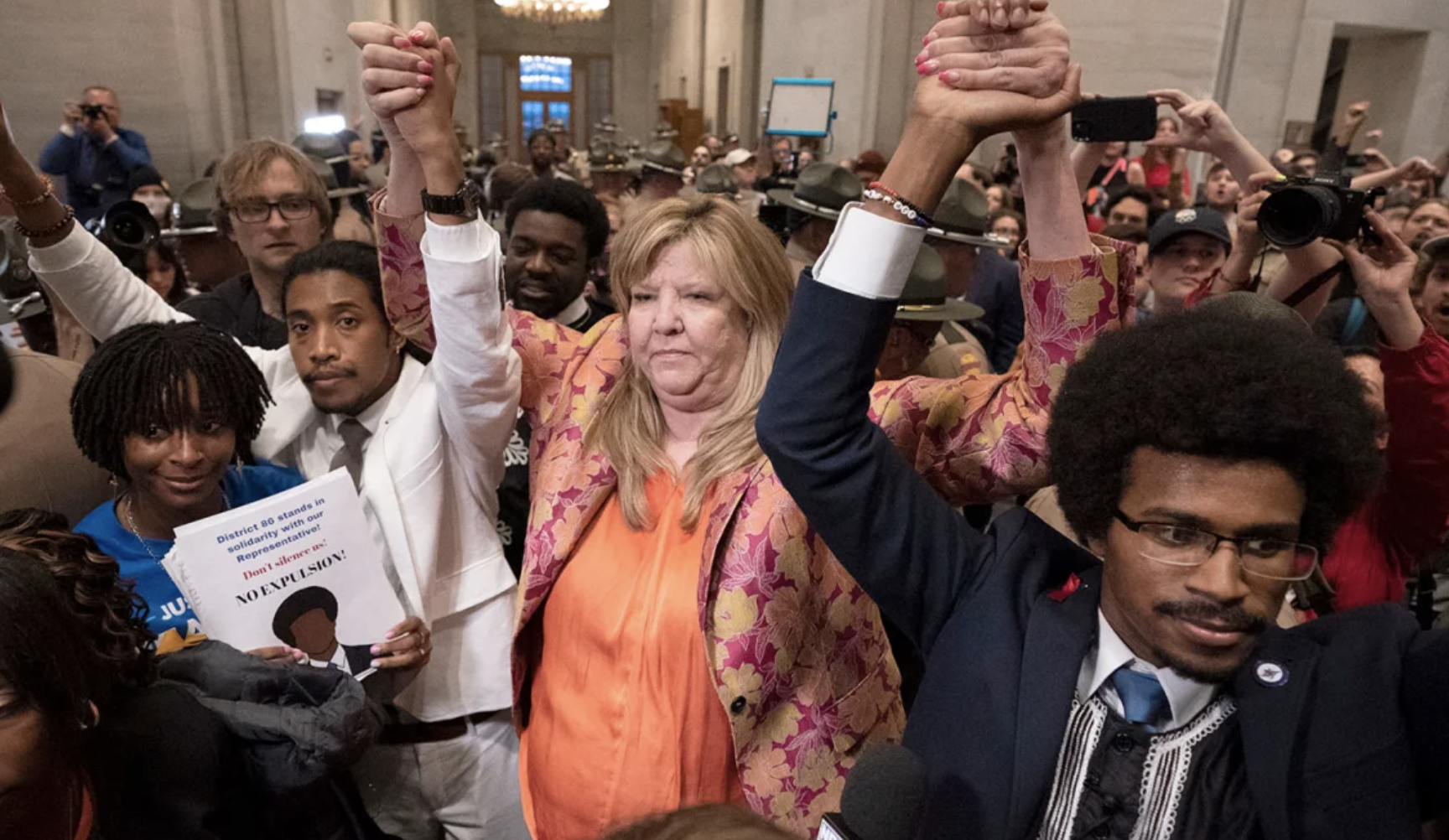
One very real, material consequence of this expulsion is that both men have lost their jobs and their health insurance. So another lesson to take from this is that even when we white-raised folks show up in solidarity, those who are Black and Brown are very likely going to endure more hardship, suffer harsher consequences than we do.
Given that, here’s what you can do from where you are. If you’re able, consider moving some money to support Justin Jones and Justin Pearson, at the link here.
What all three of these courageous Tennessee legislators have done is to see their struggle against the destructiveness of the gun lobby and the white culture that sustains it. I often have white-raised people approach me, after a lecture or via email, wanting to know what they can do about white supremacy. “Just tell me what to do,” is a common refrain. It’s simple enough: We, who are raised to believe we are white, must understand that we have skin in the game of dismantling these oppressive systems that are putting our lives at risk.
If you want to do more than make a donation, get involved where you are with other people who understand the stakes. In Tennessee, physicians are inviting people to sign this petition for gun violence prevention and you can get involved with the Southern Christian Coalition, which is mobilizing pastors and other Christians against the rise of white nationalism. And, you’re welcome to join us in SURJ, where we have a good time rolling up our sleeves and talking to other white-raised folks about what we have gain when we understand that we have skin in the game.