That Bird App, the Billionaire, and Free Speech
Some of what I've been reading.

I think my days on that bird app are coming to an end.
Earlier this year, my account got hacked and held for ransomware (some asshole on the other side of the world wanted $150 from me to get it back). Fortunately, a few friends with connections to the Before Times Bird App got my account restored, but it’s felt like I’m living on borrowed time there since then.
The hack this past summer and then the takeover by the billionaire also known as Apartheid Clyde who is hell bent on turning into Gab, have me reconsidering what being on that platform has meant to me and what it will mean when it’s gone, which will likely be in a whimper of chaos and engineering failures rather than in a big bang of bankruptcy. The fact that he spent $44 billion-with-a-B to purchase this bird app in order to destroy it is either the most Afrikaner move or a psyop, or maybe both. It seems clear that he bought it as a kind of ideological impulse buy, a goof to own the libs and foment a culture war because he can.
I have to confess that the demise of that app really bums me out. Since I joined in (checks app) January, 2008, I’ve used it to think with, meet friends, and generally reshape what it means to be a scholar. For example, this peer-reviewed academic article started as a grousing tweet at an academic conference. Part of what I have loved about Twitter is the ability to transform the solitary academic-writing-life into a more communal endeavor. I have met real, true friends there who help me think through ideas and would, in the Before Times, meet up for day drinking, or a movie, or a book reading. During the pandemic, it helped me sustain a certain amount of social connection to my fellow humans. It’s been the perfect amount of parasocial for someone who, like me, enjoys an 80:20 ratio of books-writing-alone-time to face-to-face interaction.
I’ve also been critical of the before the billionaire Twitter for the way that it has so efficiently mainstreamed white supremacist talking points. This, too, bums me out because when I consider the loss I feel when I contemplate that bird app going away, I have to interrogate my own complicity in the white supremacy it enabled.
I’m not leaving just yet, and I’ve signed up on all the other platforms people are recommending, but none of them are appealing right now. Take Mastodon, for example. As Dr. Johnathan Flowers explains in this interview with Justin Hendrix for Tech Policy Press:
Mastodon is a very white space. It draws upon some of the values and some of the interests of indie web producers, of the DIY tech community, wherein there’s this sense of rugged individualism. …As I said, Mastodon is a very white platform, and insofar as I’m saying it’s a very white platform, here I’m drawing on the work of Sara Ahmed in her piece A Phenomenology of Whiteness, who argues that spaces inherit the orientations of the people within them. So if you have a space that is predominantly populated by white persons regardless of their other identities, if you are in a space primarily populated by white persons, the norms, the habits, the very structure of that space will take on a likeness to whiteness by virtue of how the majority of people participate in that space. As I said, Mastodon is a very white space. It is not unlike other tech spaces where whiteness is predominant. Insofar as this is the case, the norms, the habits, the affordances of the platform will inherit whiteness. …Again, when you have a majority of the individuals in a space being white, that space will take up the habits, the norms, the perspectives, the orientations of the users or bodies within it. Insofar as the majority of the users on Mastodon are white, then they take up the kinds of ways that whiteness organizes space, including an entitlement to freedom from say, understanding one’s complicitness and racism or freedom from engaging with experiences of racism as made present by users of color.
I think Dr. Flowers is 100% correct about all this and it’s a big reason why I don’t think I’ll ever match with Mastodon. The prevailing orthodoxy (both left and right) is that “whiteness” is just another racial identity like any other. On the left, this comes through in a multicultural frame as “valuing all voices.” On the right, it’s an identity that some want to riot for, vote for, and even die for.
But the ‘norms and habits’ of whiteness are not neutral. The norms and habits of whiteness do not make up just another racial identity. Whiteness is domination. And, whiteness is corrosive to those of us who inhabit it. We convey whiteness through the technologies we create and the stories we tell about them.
The fact that the billionaire from South Africa has called himself a “free speech absolutist” doesn’t connect to any constitutionally recognized understanding of the First Amendment. It does work as a signal to his fan-boys on the far right and very effectively as a free pass to fucking Nazis. The thing is, it’s not really about free speech at all. It’s about an expansive sense of entitlement and an absolute refusal to recognize the humanity of others deemed ‘less than’ based on one’s identity or affiliation with ‘wokeness.'
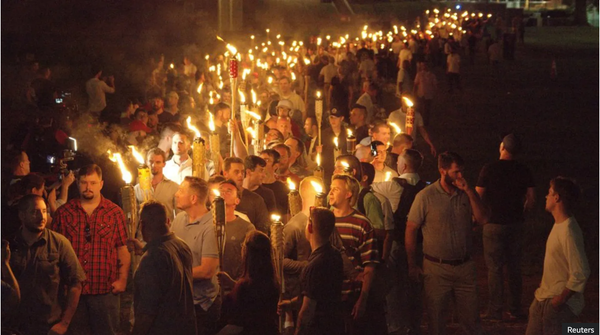
I just finished reading journalist PE Moskowitz’s terrific book, The Case Against Free Speech: The First Amendment, Fascism and the Future of Dissent. In this compelling narrative, Moskowitz recounts their experience being at the “Unite the Right” rally in Charlottesville. They were close by when Heather Heyer was killed by a guy who drove his car through a clutch of antifascist protesters.
“Charlottesville, it turned out, was a real-time exercise in free speech politics,” Moskowitz writes.
“By the end of the rally, after I and hundreds of others ran from the gray Dodge Challengers, after I saw Heather Heyer’s lifeless body being lifted into an ambulance and sat in shock, smoking a cigarette with a friend on a curb as police in armored vehicles rushed past us, I thought, How could we have been so naïve? The violence, in retrospect, seemed inevitable. How could it not end like this?”
I have this feeling, too. It’s like we’re on this same trajectory with that bird app of ever more dangerous speech that will lead to more violence, and it already has. Yet we, here in the US, are being willfully ignorant if we don’t recognize this.
In the US, the centrist-ACLU-version of “we must defend Nazis’ speech” approach has been conjoined with the “information wants to be free” ethos of early tech-bro internet culture, most often associated with John Perry Barlow’s A Declaration of the Independence of Cyberspace (from 1996). Younger readers may scoff at this ancient reference, but read it again if you haven’t as this ethos has animated much of the C-Suite at tech companies. That ethos seeded the ground for the current red-pilling, including of the billionaire in question.
Moskowitz is mostly concerned with challenging the centrist-version of free speech and argues that part of what’s been lost is a materialist view of free speech politics. In other words, where you’re situated in the world has everything to do with what kind of speech you can exercise. As Moskowitz writes:
“the ability to speak without consequence is significantly more limited for someone living in poverty and at risk of police brutality than for someone who can broadcast their speech on television and radio. … [When] detached from materialist politics that interrogate who actually has the power to change things, free speech does little to give those without power more of it.”
The materialist basis of speech rights is playing out now as the new CEO threatens to fire staff who leak information to the press that’s unflattering to their new boss, while he feeds company info to propagandists like Matt Taibbi and Bari Weiss to promote his conspiracy theory about the ‘Twitter files.’
The materialist basis of speech rights is nowhere clearer than in the decision to fire the cleaning staff at Twitter headquarters just weeks before Christmas because they dared to strike. One of the fired workers was told by someone in the boss’s office that “his job would be obsolete soon anyway because robots would eventually replace human cleaners.”
Obviously, Apartheid Clyde doesn’t really care about “free speech,” in any meaningful way. He just wants to be able to say whatever he wants, while restricting what other people say, and he can do this because of his enormous wealth.
But what about the rest of us, who really do care about free expression?
There are other ways a society can value free expression alongside the right not to be annihilated. That way is to adopt a human rights approach to “speech,” wherein the right to free expression and dissent from the government is not absolute but is weighed in the balance against other, equally important, rights.
The human rights framework is the approach several European nations took following WWII and those laws can have real-world consequences for tech companies here in the US. Obviously, this is not a panacea for combatting the far right, as 25 were arrested last week for plotting a coup to overthrow the democratically elected German government and install an authoritarian leader.
But we here in the US have not learned those lessons that dangerous speech can and does lead to an insurrection and to genocide. Or, we think in our delusion of American exceptionalism, that we are somehow exempt from these historical lessons. We’re living through dangerous times, not because of “polarization,” but specifically because of the white supremacy baked into this thing called America.
One of the lessons I’ve taken away from my time on that bird app is that we really do need something like it: a public square that enables people to connect across our difference and Twitter gave us that illusion. Tressie McMillan Cottom said this better on Trevor’s show. It’s not simply the loss of that illusion, it’s that Apartheid Clyde is now actively weaponizing the platform to go after people he perceives as political enemies.
I don’t know when my last day logging into that bird app will be, but it’s coming. I’ve donated to the kickstarter for Project Mushroom, which right now, looks like the most promising of the alternatives out there. I learned about it from women of color activists that I admire, like Mariame Kaba and Kelly M. Hayes.
I’ll see y’all over there.