The Problem with 'Extremism'
How Both-Sides-Ism Confuses Us
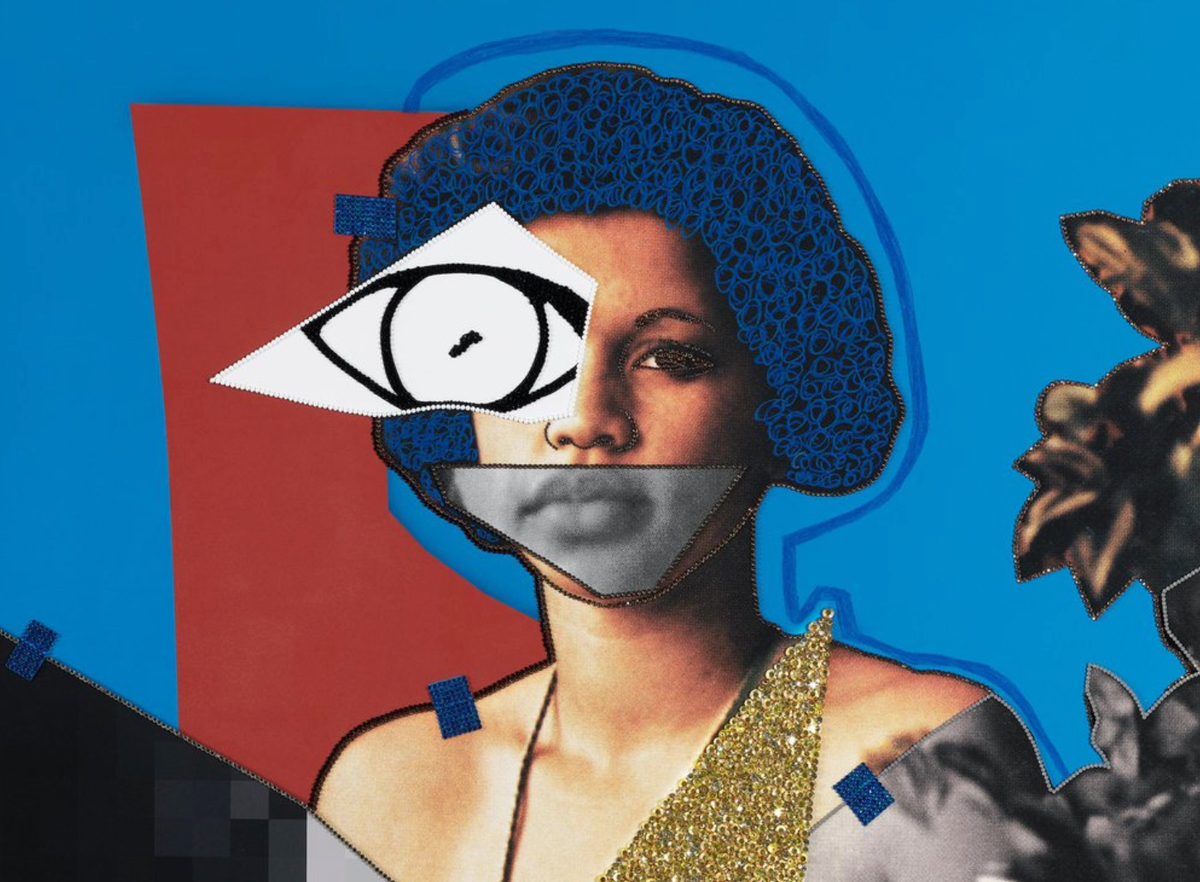
I love magazines. The printed kind. I save them up, and read them by the stack. Sometimes, I will even go back through the pages of my stack of printed magazines and cut out images and words to make very bad collage art.
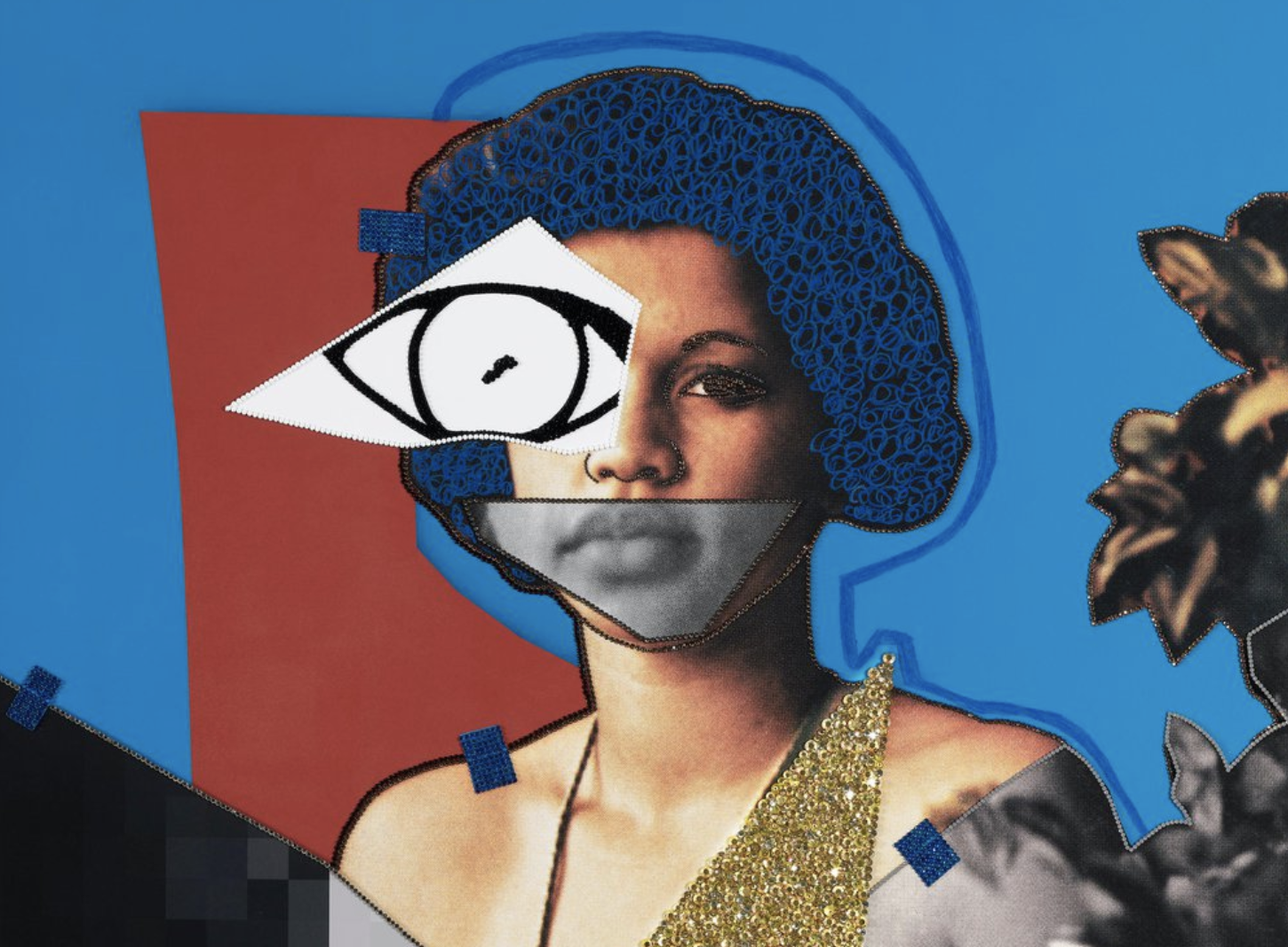
In my stack of magazines, I’d been looking forward to the new issue of The Atlantic, which has a cover story with the title, “The New Anarchy” and the alarming-and-intriguing subtitle: “America faces a type of extremist violence it does not know how to stop.”
The mere mention of ‘extremist violence’ is a kind of catnip for me as I work on this combatting the far right project, so I was intrigued. I was encouraged, too, by the epigraph that opens the piece, from Abraham Lincoln. You’ll forgive me if, based on these early cues, I assumed this article was going to grapple with the long history of white supremacist extremist violence in the U.S.
Dear Reader: it does not.
I had to go have a look at that bird app once I got done reading it to see if anyone else had picked up on what I had in this mess of an article, and of course, the fabulous Jamelle Bouie called it when he said, “Very odd to read a feature length essay about irregular political violence in the united states and not see any attempt to consider the years of roughly 1868 to 1898.” Yeah, very odd, indeed.
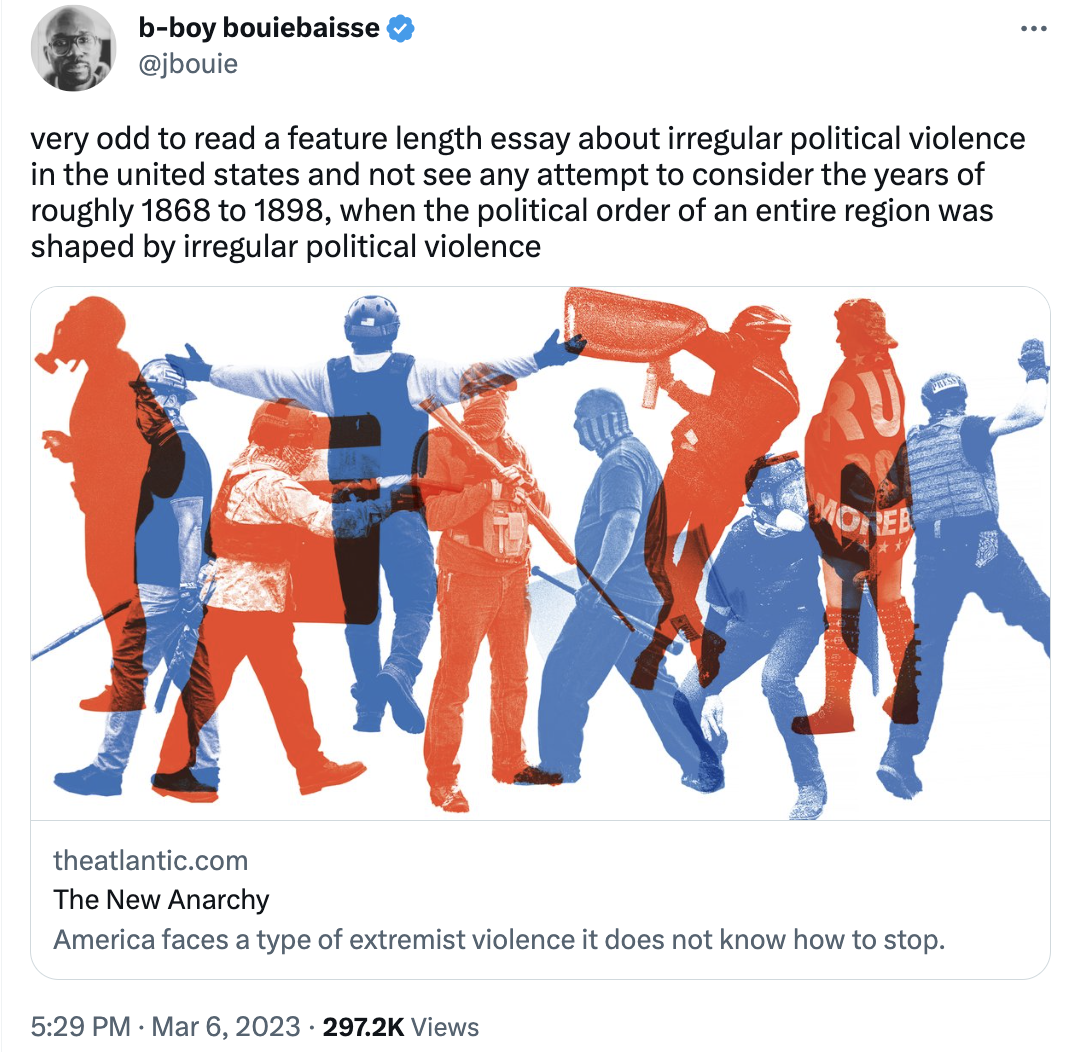
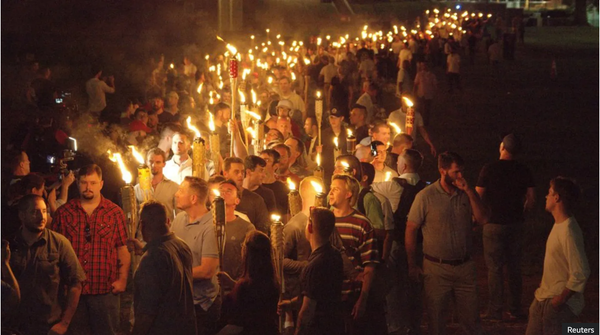
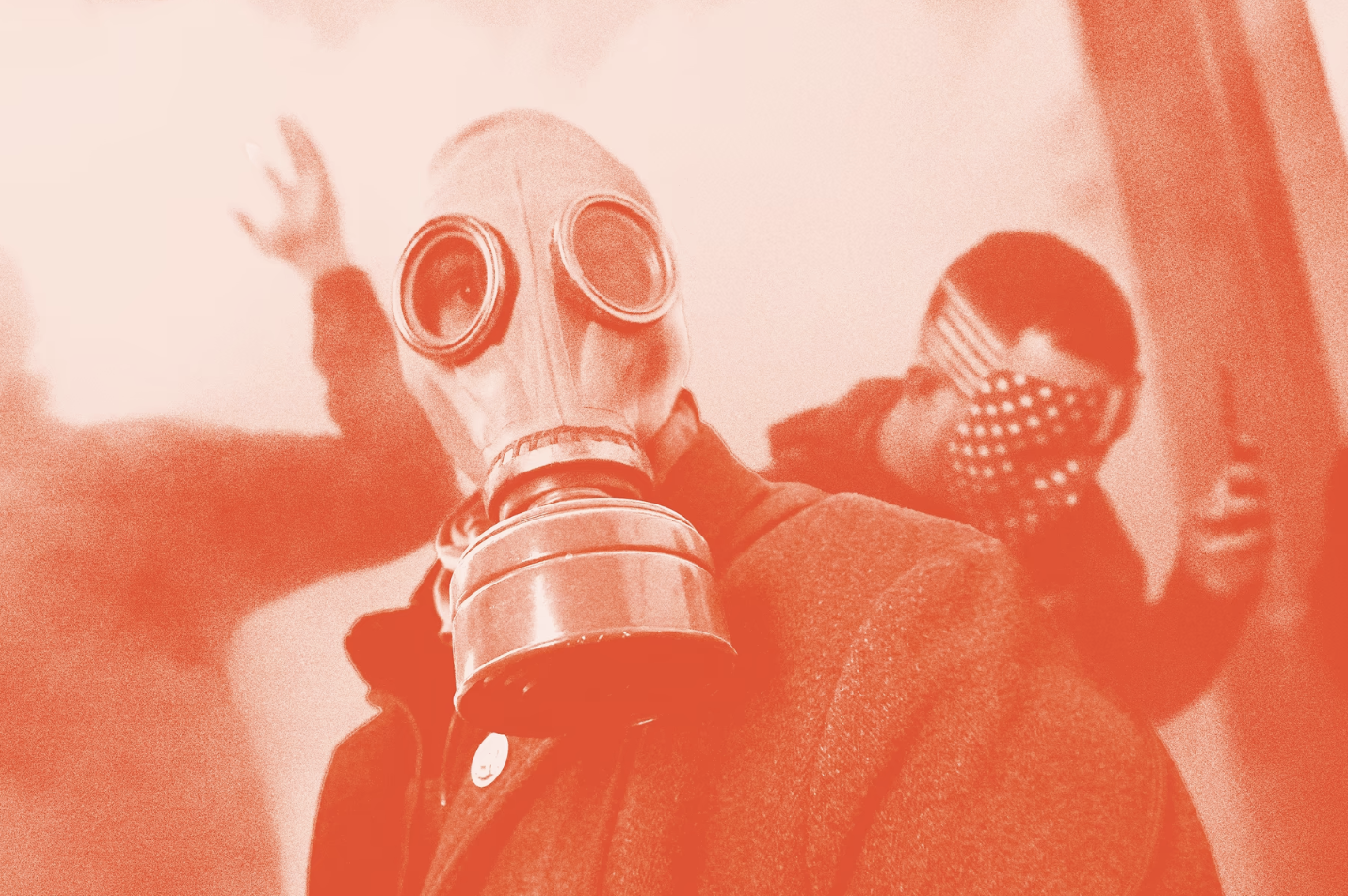
The piece is written by Adrienne LaFrance, the executive editor at The Atlantic, and she chooses to focus on literal anarchists both here in the U.S. and in Italy. It starts with a long discussion of the events in Portland, Oregon - a key trope in the piece - and the volatile summer of 2020, and about this, LaFrance writes:
Extremists on the left and on the right, each side inhabiting its own reality, had come to own a portion of downtown Portland.
This is the conventional wisdom that animates the entire piece and leads LaFrance (and her thousands of readers) down a misbegotten path of false equivalence. Rather than drawing on the long history of white supremacist organizing that lead to the formation of Portland (including in a 2016 piece in The Atlantic “The Racist History of Portland, America’s Whitest City”) LaFrance instead points to the liberal reputation of Portland as somehow the root cause of the Proud Boys showing up there:
The city is often mocked for its infatuation with leftist ideas and performative politics. That reputation, lampooned in the television series Portlandia, is not completely unwarranted. Right-wing extremists understood that Portland’s reaction to a trolling campaign would be swift, and would guarantee the celebrity that comes with virality.
In other words, if Portlanders hadn’t been so liberal, there wouldn’t have been any trouble with the Proud Boys. She continues to both-sides this:
When Trump won the presidency, this dynamic intensified, and Portland became a place where radicals would go to brawl in the streets. By the middle of 2018, far-right groups such as the Proud Boys and Patriot Prayer had hosted more than a dozen rallies in the Pacific Northwest, many of them in Portland. Then, in 2020, extremists on the left hijacked largely peaceful anti-police protests with their own violent tactics, and right-wing radicals saw an opening for a major fight.
This clause “Portland became a place where radicals would go to brawl in the streets,” seems to suggest that the real problem in 2016 was “radicals” brawling and not the fascist that 53% of white women had just elected to the presidency. From here, the article jumps to a discussion about the “Years of Lead,” - referring to the decades of violence, roughly 1967-1982, in Italy. While there may be interesting parallels between Italy and the U.S. when it comes to violence, it seems far-fetched and intentionally distracting to use this comparison, or at least the way this author does. (Frankly, once she mentioned “Years of Lead,” it seemed clear that she listened to this podcast by the same name, and then tried to retrofit her article about the U.S. to be able to include it.) It was around this point that I realized Ms. LaFrance is an unreliable narrator when it comes to explaining “extremist violence,” but she’s not alone in this.
This article is just the most recent example of an entire framework known as “countering violent extremism” or CVE. In this framework, all “EXTREMISM” is the same. Far left extremism is the SAME AS far right extremism. Therein lies the problem. If extremism is the problem, then there’s no way to hold a far right regime accountable.
The way that CVE gets used is as a counterterrorism strategy by the State. In the disaster that followed 9/11, the U.S. government’s increased surveillance on Muslim communities and CVE became synonymous with Muslim community control. It did this in a number of insidious ways. CVE program try to recruit community leaders, social workers, teachers, and health providers to assist the government in identifying individuals that may be “at risk” of becoming violent extremists, even though this idea of individual risk factors has been discredited by decades of scholarly research. CVE has been targeted almost exclusively at Muslim communities, using spurious criteria, such as religiosity, political activism or vague feelings of alienation as proxies for violent tendencies. But the broader framework of CVE situates all forms of extremism — whether motivated by political ideologies on the left or right — as equally harmful.
Some have argued that we should designate white supremacists as domestic terrorists, as one way to combat the far right. But, I’m not so sure this is the path forward. Given how thoroughly “terrorist” has become racialized to mean Muslim, Black or Brown people, it will never be effectively used against white supremacy because it leaves us in the cul-de-sac of “extremism,” a circular dead-end.
This focus on “extremism” popular among those in CVE and some in journalism is related to another common misunderstanding of the current political landscape: polarization. Another branch of the conventional wisdom tree is that we’re becoming “polarized” equally on the left (blue states) and right (red states) in the U.S. because of the different “filter bubbles” in which we reside. This is simply not true. The truth is much more one-sided than that.
What we’re experiencing is a decades-long, right-ward takeover of the federal government by a theocratic minority driven by FoxNews, talk radio and social media, fueled by a whitelash response to the first Black president, the right to gay marriage and the mere existence of trans people. Which brings me back to the article by Ms. LaFrance.
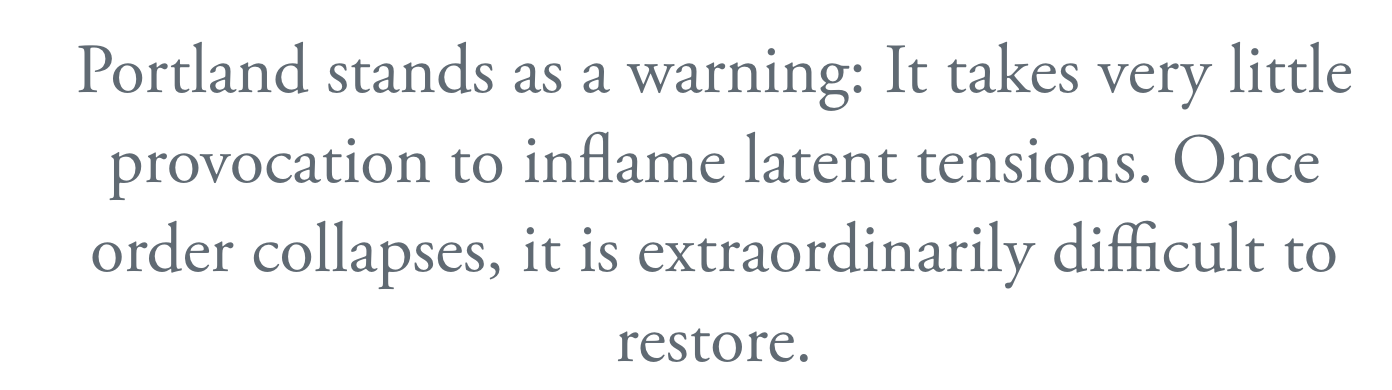
It isn’t “Portland” as the signifier of the wishy-washy-left that leads to even more violence as Ms. LaFrance suggests here. It’s Portland, the “whitest city in America,” in a state with a legacy of white supremacy and present-day history of creating a whites-only, settler colony. Giving in to the false narrative equivalency of both-sides explanations of extremism that Ms. LaFrances wants to tell only serves to lead us astray from understanding what’s really happening. Even worse, Ms. LaFrances leaves us with no solutions, as we are stuck in this “terrifying cycle of violence,” that America “doesn’t know how to fix.” My research on combatting the far right suggests that there are lots of things to be done if only we can find the political will to try them.
I look forward to making some (very bad) collage art out of Ms. LaFrance’s article, and listening to a new podcast from The Atlantic by Vann R. Newkirk, II, called “Holy Week,” the story of a revolution undone, about the civil rights movement after the death of Dr. King. It’s really good.