Witnessing
What does it mean to witness genocide?
I’m writing this with one-eye closed. I’ve had an injury to my left eye. It happens when my eyes get too dried out, so that when I awake in the morning and open my eyes the eyelid tears off the top layer of the cornea. Unbelievably painful. The good news is that the eyes are phenomenal at self-healing and by tomorrow this time, it should be back to normal. Partly, this is a sign from my body that I have been working too much, which for me means lots of screen time. And, I will re-up my subscription to those (outragesouly expensive) lubricating eye drops to prevent this happening again. I’ve found the timing of this eye injury interesting. Perhaps my body’s response to witnessing genocide is to shut down the operation of half my sight.
On Monday this week, as the Israel-Hamas war began, I found myself reflecting on what it means to witness genocide from behind our screens. We are not built to witness genocide from the slick remove of laptop and iPhone screens and not be able to do anything about it and then go on being fully, functioning human beings. It’s a distortion of reality to see death and destruction, and then go about our day. I think it changes us in profound ways, mostly not for the better.
Let me be clear, I don’t think that looking away is the answer. I think stopping genocide is the answer.
I think a lot about (surely, more than is healthy) a scene in that film Mudbound (2017), about two World War II veterans who were friends in the army, one of then white, one of them Black, and their return to rural Mississippi and the Jim Crow South. When the Black veteran is viciously attacked by some violent racists, his white friend (there was a name for this kind of friend where I grew up) is forced to watch the attack. Certainly, what the Black veteran experienced was worse, way worse than what is friend experienced. But what the white veteran experienced was not nothing. Today, we might call it "vicarious trauma." Reflecting back, I see that I experienced this from watching way too much CNN coverage of the Oklahoma City bombing back in 1995 (more about all that another time).
My point here is, when confronted with genocide-through-screens, you either go to a deep place of empathy for people experiencing that trauma, which is not without its own psychological consequences OR, you shut down, numb yourself out with more screens, substances, or compulsive behaviors.
People who are trying to make the tech world better often speak of “human-centered design,” that is, design of technologies that take the human into account. But what we have now is the opposite, call it “designed to f*ck up humans by design.”
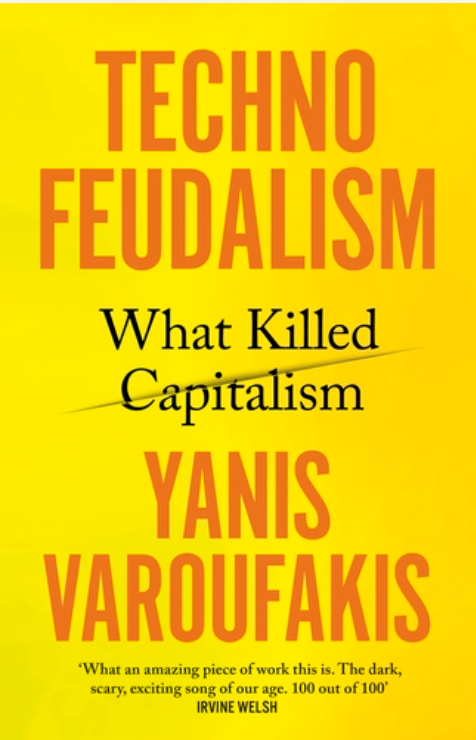
I think I’m coming to a place where I agree with Yanis Varoufakis, a former Greek politician who is writing about the big tech platforms. He says in a new book, Technofeudalism, that we have to seize the means of technological production. (The book is not published in the US until early 2024, so my comments here are based on interviews the author has been doing.) He's making this argument from a Marxist, economic point and, I tend to agree. What I appreciate about Varoufakis’s take is that he connects our current moment to the 1770s, when Adam Smith was writing about the new economic system of capitalism. We're in a similar moment, Varoufakis argues.
During the early days of the pandemic, I became obsessed with the French Revolution because I had this feeling, this tingling at the back of the neck, that we were getting close to that kind of social change. That we were inching close to a time when people would find the current situation so onerous that people would begin to call for “guillotines” as the only solution. That led me down a path of thinking about the Haitian Revolution, which because of my Texas-public-school-education, I didn’t realize were two, closely linked revolutions. (Here is an excellent documentary about the ties between both.) I mean, maybe you knew that the Haitian revolutionaries overthrew their enslavers, went to Paris, and were declared French citizens by the French government only to have Napoleon Bonaparte sell them out, but I didn’t know that.
Talk of revolution in Varoufakis’ book resonates with the conclusion of Kehinde Andrews’s recent call for revolution in his book, The Psychosis of Whiteness.
Violent revolutions are evidence that politics in other forms has failed. For those who want a way out of witnessing genocide, it can be difficult to find a middle ground between vicarious trauma and hardening our hearts. But I think there is one: and that’s activism. Getting involved in some kind of human-to-human action that addresses the causes of genocide is the only way that I’ve found to avoid the trauma versus the avoiding-and-hardening trap.
So, that’s what I’ll be doing this weekend, getting involved with some pals here who are launching the Institute for the Critical Study of Zionism. The place where this \event is happening is already being attacked. When Amanda, my partner, mentioned this in the car to the ER for my eye on Tuesday night, she added, “I wouldn’t want to be anywhere else.”
Yeah, me too, babe.